Expert Flat Roof Replacement & Installation in Fort Pierce, FL

Flat roofing is a different discipline than pitched roofing — and the gap between a flat roof installation that holds for 20 years and one that fails in three is almost always in decisions made before the membrane ever gets rolled out. Drainage design, substrate condition, taper, and system selection determine the outcome. The membrane is just the finish line.

Rhino Roofs provides expert flat roof replacement and installation services for residential properties across Fort Pierce, Port St. Lucie, Stuart, Vero Beach, West Palm Beach, and the surrounding Treasure Coast. We work with TPO single-ply, modified bitumen, and silicone restoration systems — and every flat roof project begins with a drainage and substrate assessment, because getting those variables right is what everything else depends on.

Specialized Flat Roof Installation Services Across the Treasure Coast

Flat and low-slope roofing demands a different set of competencies than shingle or tile work. The physics are different — water doesn’t shed by gravity the same way on a low-slope surface, so every drainage pathway has to be engineered rather than assumed. The failure modes are different — seam integrity, flashing encapsulation, and ponding water management are the locations where flat roofs succeed or fail, not the material field in between. And the performance factors are different — UV exposure is intense and sustained on a horizontal surface, and the thermal cycling that South Florida imposes on flat membranes is more demanding than most of the country ever experiences.

Our flat roof installation crews are trained specifically in low-slope systems. They understand the drainage requirements, the seam welding process, the flashing details at penetrations and wall transitions, and the substrate preparation that makes a membrane installation durable rather than just temporary. We pull all required St. Lucie County low-slope permits, handle inspection coordination, and deliver complete documentation at closeout.
High-Performance Membranes for Residential Flat Roof Replacement

The membrane system you choose determines the performance profile, maintenance demands, and service life of your flat roof. Each of the three primary systems has specific applications where it’s the right answer — and we’ll explain which one fits your situation honestly, not based on which one has the highest margin.

TPO Single-Ply Membrane Systems

TPO (thermoplastic polyolefin) is a leading choice for residential flat roofing on the Treasure Coast, offering two key advantages for South Florida: seam integrity and solar reflectance. TPO seams are heat-welded at temperatures exceeding 800°F, fusing the membrane into a continuous surface. Properly welded seams are as strong as the membrane itself, reducing leak risks compared with adhesive- or tape-sealed systems. White TPO can reflect up to 85% of solar radiation, reducing heat transfer into the home, lowering cooling loads, and limiting thermal stress on the membrane. It also resists punctures, chemicals, and biological growth—important for flat roofs exposed to HVAC maintenance and organic debris. Best for: Most residential flat roof replacements where performance, longevity, and energy efficiency are priorities.

Multi-Layer Modified Bitumen Roofing

Modified bitumen (mod-bit) is an asphalt-based flat roofing system reinforced with SBS or APP polymers for improved flexibility, strength, and resistance to thermal cracking. It has a long track record in Florida and remains a proven choice for roofs with regular foot traffic, debris exposure, or complex sections where TPO seam welding is impractical. Installed in multiple layers, mod-bit provides added thickness and redundancy, offering strong puncture resistance compared with single-ply systems. It can be self-adhered or torch-applied depending on the application. The main tradeoff versus TPO is solar performance. Standard mod-bit absorbs more heat, although reflective and granulated options can reduce the difference. TPO still offers superior solar reflectance under South Florida conditions. Best for: Flat roofs with regular foot traffic, complex geometries, and homeowners seeking a proven multi-layer system.

Liquid-Applied Silicone Flat Roof Coatings & Restoration

Tile roofs are built to last, but the underlayment beneath the tiles is the true waterproofing layer and often wears out before the tiles themselves. Many roof leaks originate from failed underlayment rather than cracked or slipped tiles, making proper diagnosis essential. Our tile roof repair services address cracked or broken tiles, slipped tiles, deteriorated mortar, damaged hip and ridge caps, valley repairs, flashing issues, and underlayment failures. We identify the true source of the problem before recommending repairs. One of the biggest advantages of tile roofing is that individual damaged tiles can often be replaced without disturbing the surrounding system. We source matching Florida tile profiles and restore valleys and flashing to ensure long-term waterproof performance.

Low-Slope Membrane System Comparison

Installation Method

Heat-welded seams

Expected Lifespan

20–25 years

Primary Advantage

Superior solar reflectance; strongest seam integrity; best overall performance in Florida sun

Installation Method

Self-adhered or torch-applied layers

Expected Lifespan

15–20 years

Primary Advantage

Multi-layer thickness; excellent puncture resistance; suited to foot traffic and complex geometries

Installation Method

Liquid-applied roller or spray

Expected Lifespan

10–15 year extension

Primary Advantage

Seamless monolithic barrier; most cost-effective path to extended service life on a sound substrate

Overcoming the Unique Challenges of South Florida Flat Roofing

Every region has its own roofing challenges. The Treasure Coast’s combination of rainfall intensity, UV exposure, and wind loads creates a specific set of conditions that flat roofing systems have to be designed for — not just installed over.
Ponding water — defined under Florida Building Code as water that remains on a roof surface 48 hours or more after a rainfall event — is the primary chronic threat to flat roof performance. Water that doesn’t drain accelerates membrane breakdown, voids most manufacturer warranties, and creates the biological growth conditions that further degrade the waterproofing surface over time. Florida Building Code requires that flat roof installations ensure positive drainage — meaning every low point on the roof must have a clear, functional pathway to a drain, scupper, or gutter within the 48-hour standard. Correcting inadequate drainage is not always as simple as repositioning a drain outlet. On flat roofs with established low spots and insufficient slope, the right solution often involves a tapered insulation board system — ISO board installed at graduated thicknesses to create positive slope across the deck surface, directing water toward drainage points rather than allowing it to collect. We assess drainage conditions as a required pre-installation step and scope any taper work clearly before membrane installation proceeds.
A pitched roof’s surface presents to the sun at an angle. A flat roof faces it directly. The cumulative UV dose a horizontal membrane receives over a South Florida summer is substantially higher than what the same membrane would experience on a vertical or angled surface — which is why UV reflectance and UV-stable material chemistry are more important in flat roofing specifications than in pitched roofing, and why we don’t use the same underlayment and membrane specifications for flat applications that we use on pitched installations.
Florida’s wind uplift requirements for low-slope roofing are among the most demanding in the country, and the perimeter and corner zones of a flat roof — where wind pressure is highest — require fastening patterns and flashing designs that reflect those demands. Membrane attachment at perimeter zones, termination bar installation, and flashing encapsulation at all wall transitions are engineered for the uplift loads your home’s wind zone designation requires, not minimized to reduce labor.
Florida’s temperature differential between a cool winter morning and a full summer afternoon creates significant daily thermal cycling stress on flat roof membranes and their seam systems. TPO’s welded seam construction and modified bitumen’s polymer-modified flexibility are both specifically engineered for this movement. A flat roof membrane that doesn’t accommodate thermal expansion cleanly will accumulate stress at its seams and termination points — which is where leaks develop.

Our Flat Roof Replacement Process — From Assessment to Sealed System

Step 1

Full System Tear-Off & Substrate Inspection. We remove all existing flat roofing layers down to the structural deck — plywood, OSB, or concrete — and inspect the full substrate for moisture saturation, delamination, rot, and structural damage. Compromised decking is replaced and documented before any new material is applied.

Step 2

Drainage Assessment & Tapered Insulation Layout. We evaluate the existing drainage configuration — drain locations, scupper positioning, and surface slope — and identify any areas of inadequate drainage. Where tapered ISO insulation board is required to achieve positive drainage, we design the taper layout before installation proceeds. This is not an optional step — it's the engineering foundation that determines whether water leaves your roof the way it's supposed to.

Step 3

Base Sheet & Sub-Layer Preparation. A heavy-duty fiberglass or polyester base sheet is mechanically fastened or adhered to the prepared deck, providing the structural foundation and vapor management layer for the primary membrane above. On existing concrete decks or substrates requiring a smooth, consistent surface, additional preparation work is completed before the base sheet is set.

Step 4

Primary Membrane Installation. For TPO systems, panels are positioned with the required overlaps and seams are hot-air welded at manufacturer-specified temperatures — fusing the sheets into a single continuous membrane. For modified bitumen, cap sheet layers are applied in sequence using self-adhering or torch-applied techniques to the specified lap dimensions and fastening pattern. In both cases, membrane application in field zones precedes detail work at perimeters and penetrations.

Step 5

Flashing Encapsulation & Final Code Inspection. All roof-to-wall transitions, parapet terminations, penetration boots, scupper openings, and perimeter edges are detailed and sealed with matching flashing components and sealant systems. After the St. Lucie County building inspector completes the final code review, we deliver your permit closeout documentation and manufacturer warranty registration.

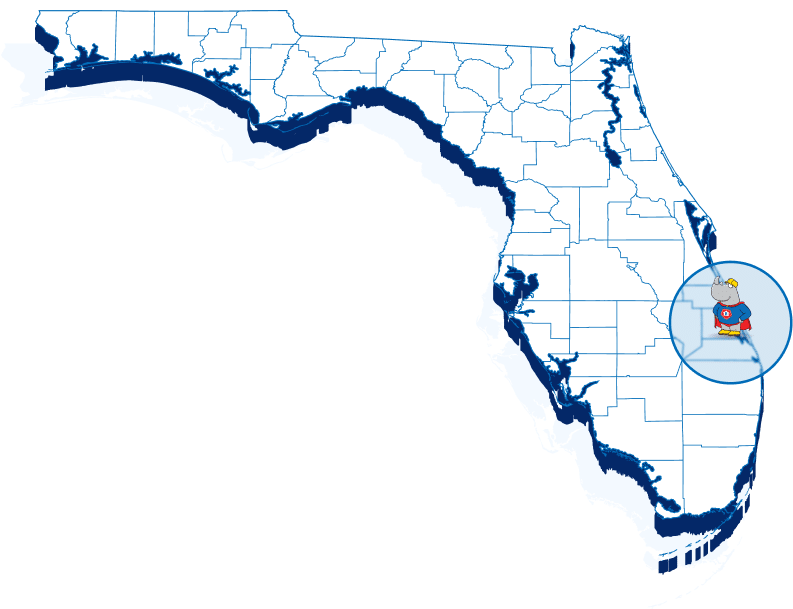
Flat Roof Service Areas — Fort Pierce & The Treasure Coast

Rhino Roofs provides residential flat roof replacement and installation services throughout Fort Pierce and the surrounding region, including:

Fort Pierce, FL

Our home base; TPO, modified bitumen, and silicone restoration

Port St. Lucie, FL

Full flat roof replacement with drainage assessment and permitting

Stuart, FL

Low-slope roofing installation and membrane replacement

Vero Beach, FL

Residential flat roof services for modern and contemporary homes

West Palm Beach, FL

Flat roof replacement and installation services

Jensen Beach, FL

TPO and mod-bit systems for coastal residential properties

Palm City, FL

Flat roof replacement and drainage correction

Hobe Sound, FL

Low-slope roofing for residential and addition applications

Sebastian, FL

Full residential flat roof services across all membrane systems

Hutchinson Island, FL

Flat roof replacement for oceanfront and coastal properties
For properties with complex drainage challenges or existing moisture issues, call us directly — those situations benefit from a conversation before the consultation.

A flat roof that drains correctly and is sealed properly should not be a recurring problem.

If you’re dealing with a chronically leaking flat section, facing a carrier inspection, or replacing a system that’s simply reached the end of its service life — Rhino Roofs is ready to assess your situation honestly and give you a clear, written path forward. That starts with a drainage evaluation, not a sales pitch.

Free consultation. No pressure. Every question answered before you decide on anything.

Frequently Asked Questions About Residential Flat Roofing

How much does a residential flat roof replacement cost in Fort Pierce?

Flat roof replacement costs on the Treasure Coast depend on the roof’s total square footage, the membrane system selected, and whether drainage correction — including tapered insulation board — is required as part of the installation scope. TPO typically represents a moderate upfront investment with strong long-term value given its 20-to-25-year service horizon; modified bitumen is comparable; silicone coating restoration is meaningfully lower cost on qualifying substrates. Because drainage assessment findings can significantly affect scope, we provide free on-site estimates that evaluate both the membrane and the drainage conditions before quoting — so the number we give you reflects what the job actually requires.

Ponding water is standing water that remains on a flat roof surface for 48 hours or more after a rainfall event. Under Florida Building Code, flat roof installations must achieve positive drainage to prevent ponding — and for good reason. Water that doesn’t drain accelerates membrane UV degradation, supports biological growth, adds structural dead load to the roof assembly, and voids most flat roof membrane manufacturer warranties. In Fort Pierce and across the Treasure Coast, where rainfall intensity during storm season can be extreme, a flat roof without adequate positive drainage will pond regularly — and the cumulative membrane damage from chronic ponding shortens service life substantially regardless of how good the installed system was.

For most residential flat roof applications on the Treasure Coast, TPO is the stronger performer across the key variables: seam integrity, solar reflectance, UV stability, and expected service life. Its heat-welded seam system provides a level of leak resistance that adhesive or torch-applied seams don’t replicate, and its reflective white surface meaningfully reduces the solar heat gain that drives cooling costs in Florida homes. Modified bitumen is the better answer for applications involving regular foot traffic, complex roof geometries where welding equipment access is limited, or smaller sections where its multi-layer redundancy adds value. We’ll recommend the right system for your specific roof based on its configuration, use conditions, and budget — not based on a blanket product preference.
Silicone coating can extend the service life of an existing flat roof by 10 to 15 years — but only if the existing system meets the substrate requirements for coating restoration. A sound membrane, properly bonded to dry insulation and structurally intact decking, is a qualifying candidate. A membrane over saturated insulation, a delaminating base sheet, or compromised deck structure is not — coating over those conditions doesn’t resolve the underlying problems, it covers them temporarily. Our flat roof assessment includes moisture scanning to evaluate substrate condition before we recommend coating versus replacement. If the substrate supports a coating, we’ll tell you. If it doesn’t, we’ll tell you that too.
Yes. Flat roof replacement and installation in St. Lucie County requires a building permit, and the completed installation must pass a final inspection confirming compliance with Florida Building Code requirements for low-slope drainage, wind uplift fastening, and material specifications. We handle all permit applications, scheduling coordination, and inspection management — you don’t navigate the building department process. The permit and inspection sign-off also become part of your permanent home documentation, which matters if your insurance carrier or a future buyer asks for proof of compliant installation.

TESTIMONIALS

John Doe
John Doe@username
Lorem ipsum dolor sit amet, consectetur adipiscing elit. Ut elit tellus, luctus nec ullamcorper mattis, pulvinar dapibus leo.
John Doe
John Doe@username
Lorem ipsum dolor sit amet, consectetur adipiscing elit. Ut elit tellus, luctus nec ullamcorper mattis, pulvinar dapibus leo.
John Doe
John Doe@username
Lorem ipsum dolor sit amet, consectetur adipiscing elit. Ut elit tellus, luctus nec ullamcorper mattis, pulvinar dapibus leo.